


在构建和训练分类模型之后,我们需要了解它的预测能力。简单地说,我们需要知道模型在处理新的未见过的数据时,是否能够准确地进行分类。通过性能评估,我们可以确定模型的优点和缺陷,进而指导我们对模型的改进和优化。
pip install scikit-learn -i https://pypi.tuna.tsinghua.edu.cn/simple/
pip install pandas -i https://pypi.tuna.tsinghua.edu.cn/simple/
接下来,我们了解下在不同的分类模型中,如何进行性能指标的计算和度量。
1. 二分类场景
1.1 准确率
对分类模型的性能评估时经常使用准确率(Accuracy)评估方法,准确率是指分类模型正确预测的样本数量与总样本数量之比。
例如:
假设:样本中有 6 个恶性肿瘤样本,4 个良性肿瘤样本。
模型 A:预测对了 5 个恶性肿瘤样本,4 个良性肿瘤样本,其准确率为:90%
模型 B:预测对了 6 个恶性肿瘤样本,3 个良性肿瘤样本,其准确率为:90%
from sklearn.metrics import accuracy_score
import pandas as pd


if __name__ == '__main__':
    # 样本集中共有6个恶性肿瘤样本, 4个良性肿瘤样本
    y_true = ['恶性', '恶性', '恶性', '恶性', '恶性', '恶性', '良性', '良性', '良性', '良性']

    # 1. 模型 A: 预测对了 5 个恶性肿瘤样本, 4个良性肿瘤样本
    y_pred = ['恶性', '恶性', '恶性', '恶性', '恶性', '良性', '良性', '良性', '良性', '良性']
    acc = accuracy_score(y_true, y_pred)
    print('acc:', acc)

    # 2. 模型 B: 预测对了 6 个恶性肿瘤样本, 3 个良性肿瘤样本
    y_pred = ['恶性', '恶性', '恶性', '恶性', '恶性', '恶性', '恶性', '良性', '良性', '良性']
    acc = accuracy_score(y_true, y_pred)
    print('acc:', acc)
acc: 0.9
acc: 0.9
1.2 混淆矩阵
准确率是一个较为粗粒度的分类评估方法,它并不能进行更加细粒度的评估场景。例如:在一个肿瘤预测的二分类问题中,我们更加看重模型对恶性肿瘤的预测能力,而不仅仅是准确率。模型 B 把所有潜在的恶性肿瘤患者全部预测出来,模型 A 只能把 5/6 的恶性肿瘤患者预测出来,哪一个模型对于当前问题场景更好呢?显然是前者。
所以,所以,我们需要引入其他的模型评估方法。
想要获得更加精细的分类评估方法,得将预测结果进行更为精细的划分,这就是混淆矩阵(Confusion Matrix)。
| 正例(预测结果) | 负例(预测结果) | |
| 正例(真实结果) | 真正例(TP) | 假负例(FN) |
| 负例(真实结果) | 假正例(FP) | 真负例(TN) |
混淆矩阵作用就是统计下在测试集中:
- 真实值是 正例 的样本中,被预测为 正例 的样本数量有多少,这部分样本叫做 真正例(TP,True Positive)
- 真实值是 正例 的样本中,被预测为 负例 的样本数量有多少,这部分样本叫做 假负例(FN,False Negative)
- 真实值是 负例 的样本中,被预测为 正例 的样本数量有多少,这部分样本叫做 假正例(FP,False Positive)
- 真实值是 负例 的样本中,被预测为 负例 的样本数量有多少,这部分样本叫做 真负例(TN,True Negative)
True Positive :整体表示样本真实的类别
Positive :第二个词表示样本被预测为的类别
例子:
样本集中有 6 个恶性肿瘤样本,4 个良性肿瘤样本,我们假设恶性肿瘤为正例,则:
- 模型 A:预测对了 3 个恶性肿瘤样本,4 个良性肿瘤样本
- 真正例 TP 为:3
- 假负例 FN 为:3
- 假正例 FP 为:0
- 真负例 TN:4
- 模型 B:预测对了 6 个恶性肿瘤样本,1个良性肿瘤样本
- 真正例 TP 为:6
- 假负例 FN 为:0
- 假正例 FP 为:3
- 真负例 TN:1
我们会发现:TP+FN+FP+TN = 总样本数量
通过上面四种情况,将预测后的结果划分为 4 部分,分别是:TP、FN、TN、FP。我们通过上述 4 种信息,构成了分类问题中的重要评估指标。
from sklearn.metrics import confusion_matrix
import pandas as pd


if __name__ == '__main__':
    # 样本集中共有6个恶性肿瘤样本, 4个良性肿瘤样本
    y_true = ['恶性', '恶性', '恶性', '恶性', '恶性', '恶性', '良性', '良性', '良性', '良性']

    labels = ['恶性', '良性']

    # 1. 模型 A: 预测对了3个恶性肿瘤样本, 4个良性肿瘤样本
    y_pred = ['恶性', '恶性', '恶性', '良性', '良性', '良性', '良性', '良性', '良性', '良性']
    matrix = confusion_matrix(y_true, y_pred, labels=labels)
    print(pd.DataFrame(matrix, columns=labels, index=labels))

    # 2. 模型 B: 预测对了6个恶性肿瘤样本, 1个良性肿瘤样本
    y_pred = ['恶性', '恶性', '恶性', '恶性', '恶性', '恶性', '恶性', '恶性', '恶性', '良性']
    matrix = confusion_matrix(y_true, y_pred, labels=labels)
    print(pd.DataFrame(matrix, columns=labels, index=labels))
    恶性  良性
恶性   3   3
良性   0   4

    恶性  良性
恶性   6   0
良性   3   1
1.3 精确率
精确率(Precision)是指被分类器正确分类的正样本(True Positive)数目与所有被分类为正样本的样本数目的比率。
比如,我们把恶性肿瘤当做正例样本,我们希望知道在模型预测出的所有的恶性肿瘤样本中,真正的恶性肿瘤样本占比。即:模型对恶性肿瘤的预测精确率有多少?
如果预测出 10 个恶性肿瘤样本,并且这 10 个也是真正的恶性肿瘤,那么精度就是 100%。如果 10 个中,只有 3 个是真正的恶性肿瘤,那么精度就是 30%.
也就是说,我们关心模型预测的准不准,并不关心预测的全不全。

例子:
样本集中有 6 个恶性肿瘤样本,4 个良性肿瘤样本,我们假设恶性肿瘤为正例,则:
- 模型 A:预测对了 3 个恶性肿瘤样本,4 个良性肿瘤样本
- 真正例 TP 为:3
- 假负例 FN 为:3
- 假正例 FP 为:0
- 真负例 TN:4
- 精确率:3/(3+0) = 100%
- 模型 B:预测对了 6 个恶性肿瘤样本,1个良性肿瘤样本
- 真正例 TP 为:6
- 假负例 FN 为:0
- 假正例 FP 为:3
- 真负例 TN:1
- 精确率:6/(6+3) = 67%
from sklearn.metrics import precision_score


if __name__ == '__main__':
    # 样本集中共有6个恶性肿瘤样本, 4个良性肿瘤样本
    y_true = ['恶性', '恶性', '恶性', '恶性', '恶性', '恶性', '良性', '良性', '良性', '良性']

    # 1. 模型 A: 预测对了3个恶性肿瘤样本, 4个良性肿瘤样本
    y_pred = ['恶性', '恶性', '恶性', '良性', '良性', '良性', '良性', '良性', '良性', '良性']

    # pos_label 指定那个类别是正例
    result = precision_score(y_true, y_pred, pos_label='恶性')
    print('模型A精确率:', result)

    # 2. 模型 B: 预测对了6个恶性肿瘤样本, 1个良性肿瘤样本
    y_pred = ['恶性', '恶性', '恶性', '恶性', '恶性', '恶性', '恶性', '恶性', '恶性', '良性']

    result = precision_score(y_true, y_pred, pos_label='恶性')
    print('模型B精确率:', result)
输出结果:
模型A精确率: 1.0
模型B精确率: 0.67
1.4 召回率
召回率也叫做查全率,指的是预测为真正例样本占所有真实正例样本的比重。例如:我们把恶性肿瘤当做正例样本,则我们想知道模型是否能把所有的恶性肿瘤患者都预测出来。

例子:
样本集中有 6 个恶性肿瘤样本,4 个良性肿瘤样本,我们假设恶性肿瘤为正例,则:
- 模型 A:预测对了 3 个恶性肿瘤样本,4 个良性肿瘤样本
- 真正例 TP 为:3
- 假负例 FN 为:3
- 假正例 FP 为:0
- 真负例 TN:4
- 精确率:3/(3+0) = 100%
- 召回率:3/(3+3)=50%
- 模型 B:预测对了 6 个恶性肿瘤样本,1个良性肿瘤样本
- 真正例 TP 为:6
- 假负例FN 为:0
- 假正例 FP 为:3
- 真负例 TN:1
- 精确率:6/(6+3) = 67%
- 召回率:6/(6+0)= 100%
from sklearn.metrics import recall_score


if __name__ == '__main__':

    # 样本集中共有6个恶性肿瘤样本, 4个良性肿瘤样本
    y_true = ['恶性', '恶性', '恶性', '恶性', '恶性','恶性', '良性', '良性', '良性', '良性']

    # 1. 模型 A: 预测对了3个恶性肿瘤样本, 4个良性肿瘤样本
    y_pred = ['恶性', '恶性', '恶性', '良性', '良性', '良性', '良性', '良性', '良性', '良性']

    result = recall_score(y_true, y_pred, pos_label='恶性')
    print('模型A召回率:', result)


    # 2. 模型 B: 预测对了6个恶性肿瘤样本, 1个良性肿瘤样本
    y_pred = ['恶性', '恶性', '恶性', '恶性', '恶性', '恶性', '恶性', '恶性', '恶性', '良性']

    result = recall_score(y_true, y_pred, pos_label='恶性')
    print('模型B召回率:', result)
输出结果:
模型A召回率: 0.5
模型B召回率: 1.0
1.5 F1-score
F1-score 是一种常用的性能度量指标,它综合考虑了模型的精确度和召回率,是这两者的调和平均数,其计算公式如下:

调和平均数对数据集中的较小数值更敏感。如果数据集中有极小的值,它会显著降低调和平均数的值。
from scipy.stats import hmean


print(hmean([0.0, 1.0]))
print(hmean([1.0, 0.0]))
print(hmean([0.0, 0.0]))
print(hmean([1.0, 1.0]))
0.0
0.0
0.0
1.0
所以,当精度和召回率都高的时候,f1-score 才会高。
样本集中有 6 个恶性肿瘤样本,4 个良性肿瘤样本,我们假设恶性肿瘤为正例,则:
- 模型 A:预测对了 3 个恶性肿瘤样本,4 个良性肿瘤样本
- 真正例 TP 为:3
- 假负例 FN 为:3
- 假正例 FP 为:0
- 真负例 TN:4
- 精确率:3/(3+0) = 100%
- 召回率:3/(3+3)=50%
- F1-score:(2*3)/(2*3+3+0)=67%
- 模型 B:预测对了 6 个恶性肿瘤样本,1个良性肿瘤样本
- 真正例 TP 为:6
- 假负例 FN 为:0
- 假正例 FP 为:3
- 真负例 TN:1
- 精确率:6/(6+3) = 67%
- 召回率:6/(6+0)= 100%
- F1-score:(2*6)/(2*6+0+3)=80%
from sklearn.metrics import f1_score


if __name__ == '__main__':

    # 样本集中共有6个恶性肿瘤样本, 4个良性肿瘤样本
    y_true = ['恶性', '恶性', '恶性', '恶性', '恶性','恶性', '良性', '良性', '良性', '良性']

    # 1. 模型 A: 预测对了3个恶性肿瘤样本, 4个良性肿瘤样本
    y_pred = ['恶性', '恶性', '恶性', '良性', '良性', '良性', '良性', '良性', '良性', '良性']

    result = f1_score(y_true, y_pred, pos_label='恶性')
    print('模型A f1-score:', result)


    # 2. 模型 B: 预测对了6个恶性肿瘤样本, 1个良性肿瘤样本
    y_pred = ['恶性', '恶性', '恶性', '恶性', '恶性', '恶性', '恶性', '恶性', '恶性', '良性']

    result = f1_score(y_true, y_pred, pos_label='恶性')
    print('模型B f1-score:', result)
输出结果:
模型A f1-score: 0.67
模型B f1-score: 0.8
2. 多分类场景
在评估多分类模型性能时,我们经常会使用一些指标来衡量其表现。其中,micro-averaging、macro-averaging 和 weighted-averaging 是常见的评估指标之一。它们在衡量分类器的精确度、召回率和 F1 分数时发挥着重要作用。
假设:三分类的真实标签和预测标签如下:
y_true = ['好评', '好评', '好评', '中评', '中评', '差评', '差评', '差评', '差评', '差评']
y_pred = ['好评', '好评', '好评', '好评', '中评', '差评', '好评', '中评', '差评', '中评']
对应的混淆矩阵:
    好评  中评  差评
好评   3   0   0
中评   1   1   0
差评   1   2   2
每个类别的评估分数:
精确率:		 [0.6        0.33333333      1.        ]
召回率:		 [1.         0.5             0.4       ]
f1-score:	 [0.75       0.4             0.57142857]
from sklearn.metrics import precision_score
from sklearn.metrics import recall_score
from sklearn.metrics import f1_score
from sklearn.metrics import confusion_matrix
import pandas as pd


if __name__ == '__main__':

    y_true = ['好评', '好评', '好评', '中评', '中评', '差评', '差评', '差评', '差评', '差评']
    y_pred = ['好评', '好评', '好评', '好评', '中评', '差评', '好评', '中评', '差评', '中评']

    # 混淆矩阵
    labels = ['好评', '中评', '差评']
    matrix = confusion_matrix(y_true, y_pred, labels=labels)
    matrix = pd.DataFrame(matrix, columns=labels, index=labels)
    print(matrix)
    print()

    # 返回所有类别分数
    result = precision_score(y_true, y_pred, average=None, labels=['好评', '中评', '差评'])
    print('精确率:\t\t', result)

    result = recall_score(y_true, y_pred, average=None, labels=['好评', '中评', '差评'])
    print('召回率:\t\t', result)

    result = f1_score(y_true, y_pred, average=None, labels=['好评', '中评', '差评'])
    print('f1-score:\t', result)
2.1 micro-averaging
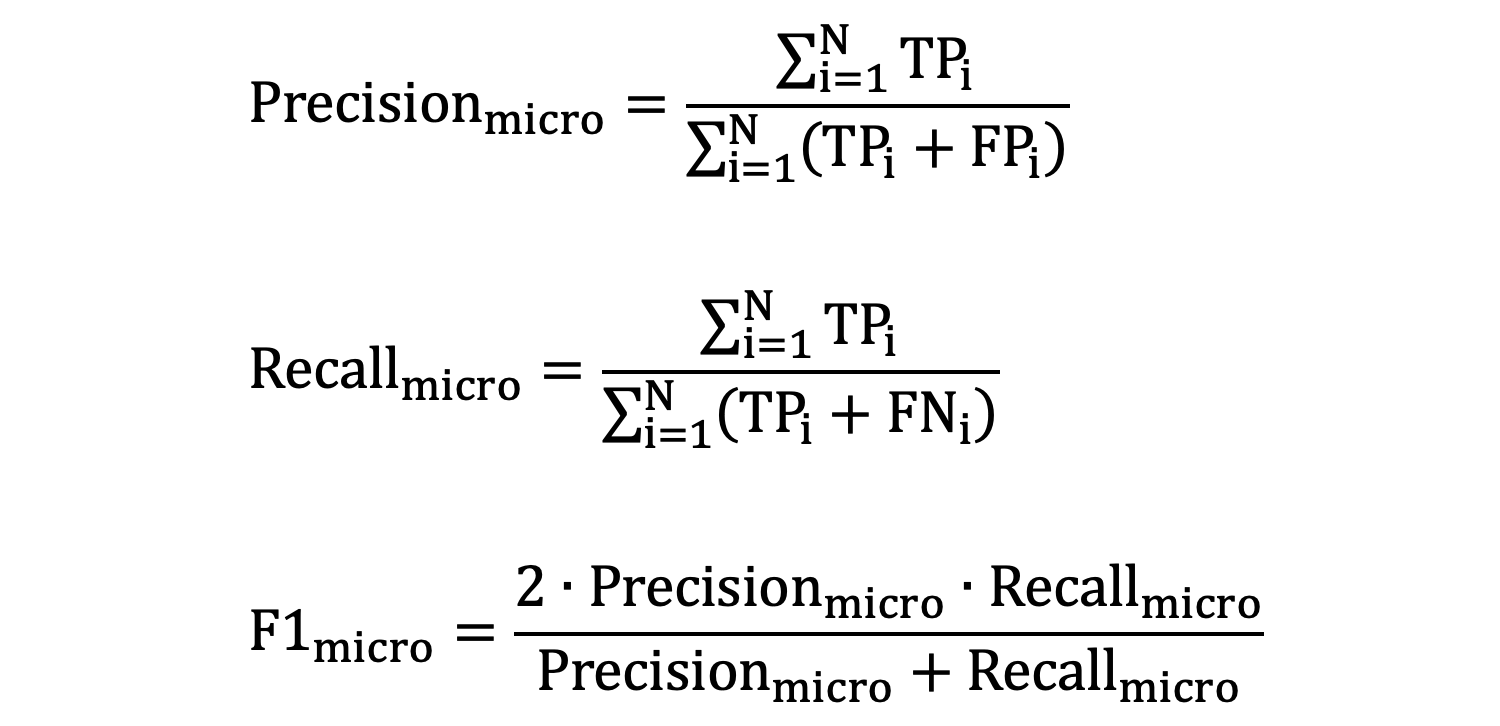
- \(N\) 是类别总数
- \(TP_{i}\) 是第 𝑖 个类别的 TP 之和
- \(FP_{i}\) 是第 𝑖 个类别的 FP 之和
- \(FN_{i}\)是第 𝑖 个类别的 FN 之和
我们以前面例子为例:
好评:
TP = 3 (预测为好评且实际为好评)
FP = 1+1 = 2 (预测为好评但实际为中评和差评)
TN = 1+2+2 = 5 (预测不是好评且实际也不是好评,包括中评和差评)
FN = 0+0 = 0 (实际为好评但预测不是好评)

中评:
TP = 1 (预测为中评且实际为中评)
FP = 0+2 = 2 (预测为中评但实际为好评和差评)
TN = 3+2+1+0 = 6 (预测不是中评且实际也不是中评,包括好评和差评)
FN = 1+0 = 1 (实际为中评但预测不是中评)

差评:
TP = 2 (预测为差评且实际为差评)
FP = 0+0 = 0 (没有将其他类别预测为差评)
TN = 3+1+1 = 5 (预测不是差评且实际也不是差评,包括好评和中评)
FN = 1+2 = 3 (实际为差评但预测不是差评)


每个类别的 TP、FP、TN、FN 值分别是:
好评:TP=3, FP=2, TN=5, FN=0
中评:TP=1, FP=2, TN=6, FN=1
差评:TP=2, FP=0, TN=6, FN=3


此时:
TP = 3 + 1 + 2 = 6
FP = 2 + 2 + 0 = 4
TN = 5 + 7 + 6 = 18
FN = 0 + 1 + 3 = 4
使用上述计算得到的 TP、FP、TN、FN 值:
- micro-averaged precision:
TP/(TP+FP) = 6/(6+4) = 0.6 - micro-averaged recall:
TP/(TP+FN) = 6/(6+4) = 0.6 - micro-averaged f1-score:
2*(micro-averaged precision * micro-averaged recall) / (micro-averaged precision+micro-averaged recall) = 2*(0.6*0.6)/(0.6+0.6) = 0.6
from sklearn.metrics import precision_score
from sklearn.metrics import recall_score
from sklearn.metrics import f1_score


if __name__ == '__main__':

    y_true = ['好评', '好评', '好评', '中评', '中评', '差评', '差评', '差评', '差评', '差评']
    y_pred = ['好评', '好评', '好评', '好评', '中评', '差评', '好评', '中评', '差评', '中评']

    result = precision_score(y_true, y_pred, average='micro')
    print('精确率:\t\t', result)

    result = recall_score(y_true, y_pred, average='micro')
    print('召回率:\t\t', result)

    result = f1_score(y_true, y_pred, average='micro')
    print('f1-score:\t', result)
精确率:		 0.6
召回率:		 0.6
f1-score:	 0.6
2.2 macro-averaging
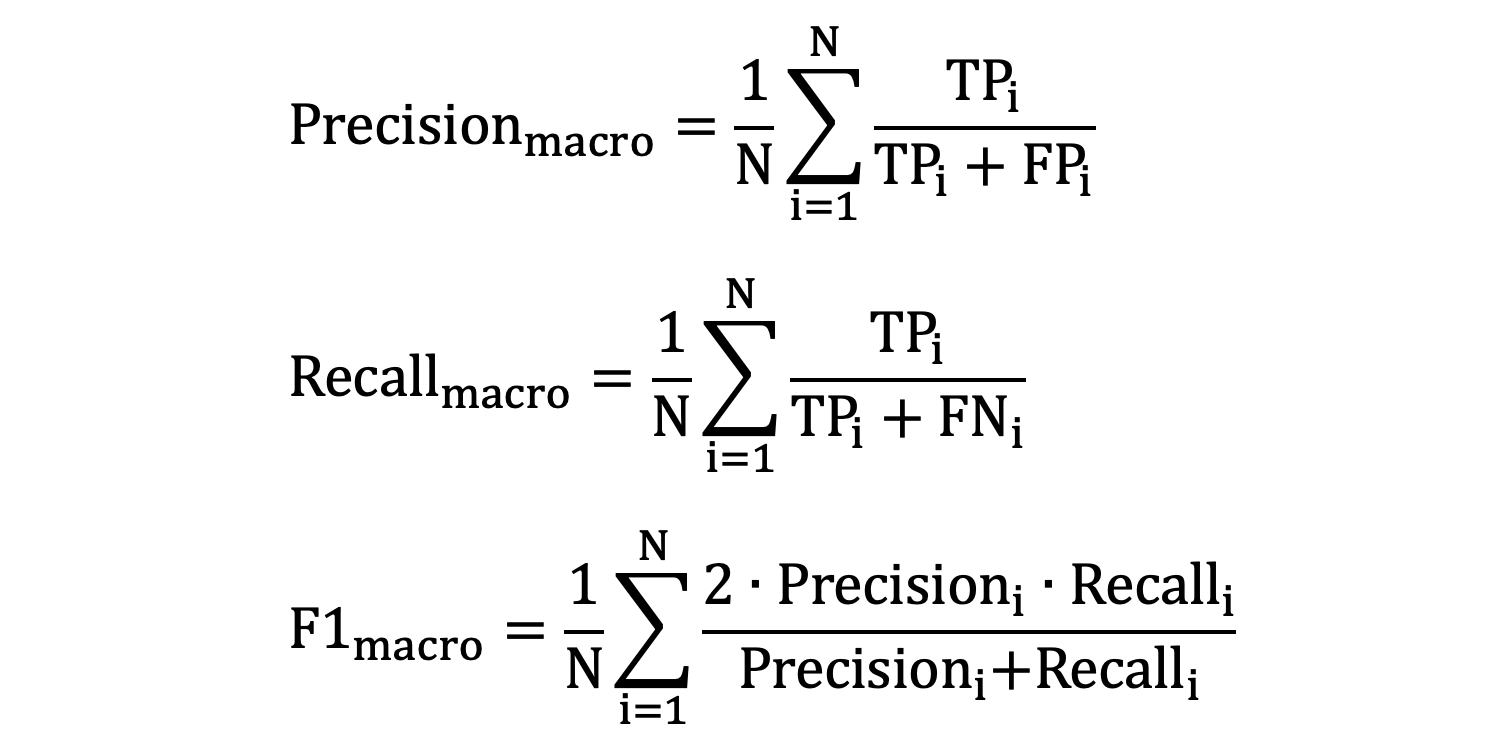
macro-averaging 计算每个类别的精确度、召回率和 F1 分数,然后对它们取算术平均值。
好评:
精确率:0.6
召回率:1.0
f1-score:0.75


中评:
精确率:0.33
召回率:0.5
f1-score:0.4


差评:
精确率:1
召回率:0.4
f1-score:0.57
- macro-averaged precision
:(0.6 + 0.33 + 1) / 3 = 0.64 - macro-averaged recall:(1.0 + 0.5 + 0.4) / 3 = 0.63
- macro-averaged f1-score:(0.75 + 0.4 + 0.57) / 3 = 0.57
from sklearn.metrics import precision_score
from sklearn.metrics import recall_score
from sklearn.metrics import f1_score


if __name__ == '__main__':

    y_true = ['好评', '好评', '好评', '中评', '中评', '差评', '差评', '差评', '差评', '差评']
    y_pred = ['好评', '好评', '好评', '好评', '中评', '差评', '好评', '中评', '差评', '中评']

    result = precision_score(y_true, y_pred, average='macro')
    print('精确率:\t\t', result)

    result = recall_score(y_true, y_pred, average='macro')
    print('召回率:\t\t', result)

    result = f1_score(y_true, y_pred, average='macro')
    print('f1-score:\t', result)
精确率:		 0.6444444444444445
召回率:		 0.6333333333333333
f1-score:	 0.5738095238095239
2.3 weighted-averaging
假设:共有 100 个样本:
好评:70,精度为:0.3
中评:20,精度为:0.6
差评:10,精度为:0.9
宏平均 = (0.3 + 0.6 + 0.9) / 3 = 0.6
在大多数样本上,模型只有 0.3 的精度,但是宏平均的精度却达到了 0.6。所以,宏平均不能真实的反映出模型在大多数样本上的表现。
weighted-averaging 计算每个类别的精确度、召回率和 F1 分数,然后将它们乘以每个类别的样本数或权重,最后将所有类别的加权平均值。它能够反应出样本在大多数样本上的表现。
加权平均:0.3 * 0.7 + 0.6 * 0.2 + 0.9 * 0.1 = 0.42,由此可以看到加权平均更加能够反映出模型在大多数样本上的表现。
接着前面的例子:
由 y_true = ['好评', '好评', '好评', '中评', '中评', '差评', '差评', '差评', '差评', '差评']
可知每个类别的权重分别为:0.3、0.2、0.5
- weighted-averaged precision:0.6 * 0.3 + 0.33 * 0.2 + 1 * 0.5 = 0.746
- weighted-averaged recall:1 * 0.3 + 0.5 * 0.2 + 0.4 * 0.5 = 0.6
- weighted-averaged f1-score:0.75 * 0.3 + 0.4 * 0.2 + 0.57 * 0.5 = 0.59
from sklearn.metrics import precision_score
from sklearn.metrics import recall_score
from sklearn.metrics import f1_score


if __name__ == '__main__':

    y_true = ['好评', '好评', '好评', '中评', '中评', '差评', '差评', '差评', '差评', '差评']
    y_pred = ['好评', '好评', '好评', '好评', '中评', '差评', '好评', '中评', '差评', '中评']

    result = precision_score(y_true, y_pred, average='weighted')
    print('精确率:\t\t', result)

    result = recall_score(y_true, y_pred, average='weighted')
    print('召回率:\t\t', result)

    result = f1_score(y_true, y_pred, average='weighted')
    print('f1-score:\t', result)
精确率:		 0.7466666666666667
召回率:		 0.6
f1-score:	 0.5907142857142857
3. 多标签场景
多标签分类是指每个样本可以被分配到多个类别中,即:可以拥有多个标签。比如:某条新闻既可以是军事类新闻、也可以是政治类新闻。
在评估多标签分类模型时,我们使用的是样本平均精确率、样本平均召回率和样本平均 F1 分数。
y_true = [['好评', '中评'], ['好评', '中评', '差评'], ['好评', '差评'], ['中评', '差评'], ['中评', '好评']]
y_pred = [['中评', ], ['好评', '差评'], ['中评', ], ['好评', '差评'], ['中评', '好评']]
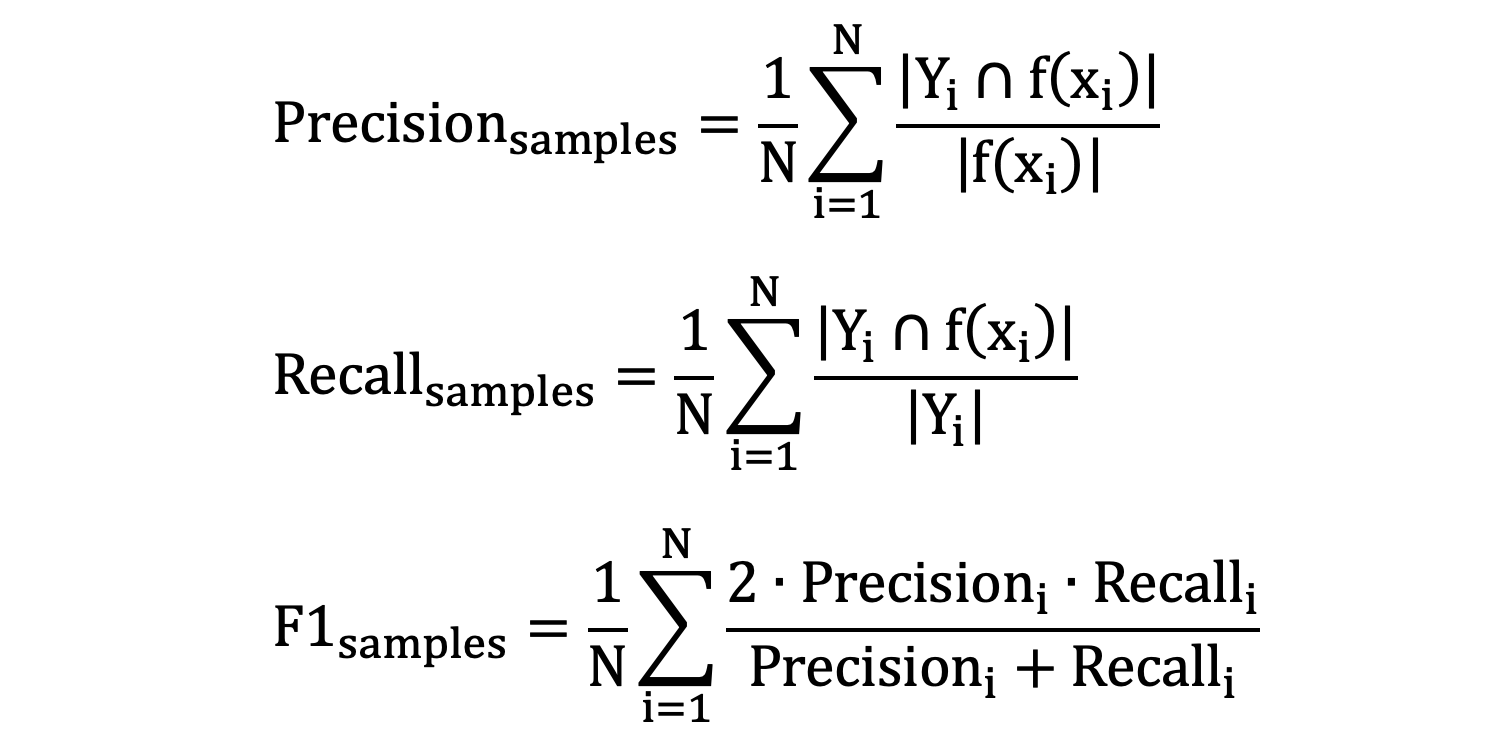
- \(N\) 表示样本数量
- \(Y_{i}\) 表示第 i 个样本真实标签集合
- \(f(x_{i})\) 表示第 i 个样本预测的标签集合
- \(Precision_{i}\) 表示第 i 个样本的精确度
- \(Recall_{i}\) 表示第 i 个样本的召回率
接下来,计算每个样本的精确度、召回率、f1-score 值如下:
样本1:
精确度:1.0
召回率:0.5
F1-score:0.6666666666666666

样本2:
精确度:1.0
召回率:0.6666666666666666
F1-score:0.8

样本3:
精确度:0.0
召回率:0.0
F1-score:0.0

样本4:
精确度:0.5
召回率:0.5
F1-score:0.5

样本5:
精确度:1.0
召回率:1.0
F1-score:1.0
计算每个指标的样本平均值:
精确度:0.7
召回率:0.5333333333333333
F1-score:0.5933333333333334
使用示例:
from sklearn.metrics import precision_score
from sklearn.metrics import recall_score
from sklearn.metrics import f1_score
from sklearn.preprocessing import MultiLabelBinarizer
import pandas as pd


if __name__ == '__main__':

    # 真实和预测标签
    y_true = [['好评', '中评'],  ['好评', '中评', '差评'], ['好评', '差评'], ['中评', '差评'], ['中评', '好评']]
    y_pred = [['中评', ], ['好评', '差评'], ['中评', ], ['好评', '差评'], ['中评', '好评']]

    # 注意:必须对标签进行重新编码
    mlb = MultiLabelBinarizer()
    y_true = mlb.fit_transform(y_true)
    y_pred = mlb.transform(y_pred)
    print(mlb.classes_)
    print(y_true)
    print(y_pred)

    result = precision_score(y_true, y_pred, average='samples')
    print('精确率:\t\t', result)

    result = recall_score(y_true, y_pred, average='samples')
    print('召回率:\t\t', result)

    result = f1_score(y_true, y_pred, average='samples')
    print('f1-score:\t', result)
['中评' '好评' '差评']
[[1 1 0]
 [1 1 1]
 [0 1 1]
 [1 0 1]
 [1 1 0]]
[[1 0 0]
 [0 1 1]
 [1 0 0]
 [0 1 1]
 [1 1 0]]
精确率:		 0.7
召回率:		 0.5333333333333333
f1-score:	 0.5933333333333334


 冀公网安备13050302001966号